Soup’s On . . .

“The degree of our freedom and self-determination varies with the level which we realize to be our self — the source from which we act. As our sense of self is narrow, the more we feel our existence as restraint. ‘And therefore,’ said Ruysbroeck, ‘we must all found our lives upon a fathomless abyss’ –so to discover that what we are is not what we are bound to be, but what we are free to be. For when we stand with our nature, seeing that there is nowhere to stand against it, we are at last able to move unmoved.” Alan Watts, of course. Nature, Man and Woman

This excerpt encourages a growing sense of the limitless possibilities for one life in spite of economic drudgery nationally, globally and, most especially, personally. And in spite of some pretty frustrating obstacles overall.

My world is roiling right now. In a good way, like a pot boils up and simmers great soup. It’s the rumbling roll of ingredients as they rush up to the surface of the best brew, that moment right before the master chef steps up and stirs, smiles and adjusts the heat.  To keep in mind that I’m not restricted like a pot on a stove, that I can embrace the tasks of the master chef – the smiling conspirator of delicious concoctions – is to know the power of my freedom. And that knowledge can propel me forward while known structures and familiar comforts fall away. And even when those dreams are inevitably but fatefully delayed. New structures, new comforts, new ways of living are always ’round the bend.

Life is good.

This Is My Goal . . .

And is something great to chew on in light of all the wonderful input here from such beautiful souls…

“Working rightly, the brain is the highest form of ‘instinctual wisdom.’ Thus it should work like the homing instinct of pigeons and the formation of the foetus in the womb–without verbalizing the process or knowing ‘how’ it does it. The self-conscious brain, like the self-conscious heart, is a disorder, and manifests itself in the acute feeling of separation between ‘I’ and my experience. The brain can only assume its proper behavior when consciousness is doing what it is designed for: not writhing and whirling to get out of present experience, but being effortlessly aware of it.”

Alan Watts – The Wisdom of Insecurity A Message for An Age of Anxiety

Obviously, we have some present experiences we will instinctvely get out of without a second thought because our brains will just know (without deliberation) that we must effect the necessary change to bring us to our best life situations and most wholesome solutions.

Speaking of! I’ve got some things to make myself more aware of! On with it…

jrk

Freedom To Be The Failure That One Is ? !

A quiet moment, birds singing, front lawn mowed, back yard begun and I have to rest a moment, this book is always waiting, so I read. One passage of brilliant and deep illumination cannot go without noting. Here it is:

“For enlightenment, or accord with the Tao, remains unrealized so long as it is considered as a specific state to be attained, and for which there are tests and standards of success. It is much rather freedom to be the failure that one is.

Unlikely as it may seem, this outrageous and nonmoral freedom is the basis of all mental and spiritual wholeness, provided…that it seeks no result. But so full an acceptance includes also this seeking, along with just anything that one happens to be doing or feeling. The apparently extreme passivity of this acceptance is, however, creative because it permits one to be all of a piece, to be good, bad, indifferent, or merely confused, with a whole heart. To act or grow creatively we must begin from where we are, but we cannot begin at all if we are not “all here” without reservation or regret. Lacking self-acceptance, we are always at odds with our point of departure, always doubting the ground on which we stand, always so divided against ourselves that we cannot act with sincerity. Apart from self-acceptance as the groundwork of thought and action, every attempt at spiritual or moral discipline is the fruitless struggle of a mind that is split asunder and insincere. It is the freedom which is the essential basis of self-restraint.”

Alan Watts (of course!), Nature Man and Woman (from the chapter titled “The World As Non-Sense.”)

I am reminded of moments even just this weekend where I was split on “what next?” And with good reason. But I realize that the moment I accepted myself unconditionally, gave myself permission to feel what I feel, to act on it with wisdom and grace, in that moment I was released to flow into decisiveness and rest. We can make a mountain, even, out of self-acceptance. Or we can rest and trust the process of surrendering to all we realize about ourselves. There is this deep abiding with self, a deep releasing of all we value (simply in the moment) that enables what is always there awaiting emergence – that wellspring of resonance with Source or Spirit or Tao and it is a tremendous opportunity to be with. Be with faults, be with failings, be with what didn’t work and why (even if the “why” is ugly-seeming), be with desires, be with even the most troubling mental disturbance and, in that being with, resting in non-judgement. Not running. Not refusing to see. Not making a decree against. Just withness. In that moment, it is as if these roiling elements simply want mommy to come along and witness. They sigh. They settle after a few whimpers. They melt gradually. They fade. And in this process self-acceptance is not forced or brought about by some acrobatic mental exposition. It simply emerges. Then we taste freedom.

So, in this sense, this freedom is “amoral.” There is no bothering with good or bad. It’s a being-withness in acceptance that provokes a release, and it is that release that enables the very thing Watts highlights as a by-product of not effort supreme or hog-tying the ego – the emergence of self-restraint, when it matters most. And when it will produce the ripest, richest fruit.

It becomes a dance with Source, with love, with whatever you suppose to be Divine. With Tao. Not grasping, grabbing to be the grand evolved one. Just unfolding, witnessing and letting go of judgement.

Why does it matter? Don’t we just need to go get the groceries, fight corruption and plan out the summer? It matters because the peace and energy such a process releases is worth more than any notion of enlightenment or success. We become – while plotting, revolutionizing and shopping – the feasts we’ve always known we could be and life cooks us up from her grandest kitchen of delights. And yes, of sorrows. And it turns out that the “failures” provide some of the best ingredients in a rich stew.

But now I ramble…time to get back to work.

Not Just "Out There," But Within.

jrk

God Re-Visited And Freedom’s Truth

The view from Alan Watts’ brilliant perspective, voiced here:

“In the West we have always admitted in theory that truly moral acts must be expressions of freedom. Yet we have never allowed this freedom, never permitted ourselves to be everything that we are, to see that fundamentally all the gains and losses, rights and wrongs of our lives are as natural and “perfect” as the peaks and valleys of a mountain range. For in identifying God, the Absolute, with a goodness excluding evil we make it impossible for us to accept ourselves radically: what is not in accord with the will of God is at variance with Being itself and must not under any circumstances be accepted. Our freedom is therefore set about with such catastrophic rewards and punishments that it is not freedom at all, but resembles rather the totalitarian state in which one may vote against the government but always at the risk of being sent to a concentration camp. Instead of self-acceptance, the groundwork of our thought and action has therefore been metaphysical anxiety, the terror of being ultimately wrong and rotten to the core.”

Nature, Man and Woman

I recall my father saying of the devil – when I was a bit of an argumentative kid going on and on about the discrepancies in judgements of right and wrong, good vs. evil and how much God does or does not get involved and if he’s in control then why doesn’t he stop this said devil – “He’s God’s Devil.” Wrap your mind around that one.

And remember in Job, what did God say to this keeper of evil? “Have you considered my servant Job?” In other words, “I dare you to knock him around, to rape his family and kill them. Do it!!!” What a huge challenge to simply prove that one man would not curse God. How holy is that?

I don’t know why I’m dragging this out but I am. No. Now I know why. I’m realizing, more and more, that I’m more invested in being an oppression ouster than anything else. And there are beliefs and whole attitudes of living that originate in this wrong notion of God as the tooth fairy or as, cringe, “good.” Why d’ya suppose he forbade such knowledge?

Courtesy of Dave Grant

I have days where I’m just not so sure I believe in any God’s existence. And then I stand under trees. God/dess is not yet and never will be measured by any religion, philosophy or belief system. But take a deep breath, feel the pulse of the earth of this planet, of your own body and you know the truth. And it’s all good/evil. It’s all there. In the blink of an eye, one moment can wipe out a life or birth another. How is that “good?” It simply is…

Alligators, rainbows and humans too! So, how can this God be good? Do we have to decree a final verdict? I think that, instead, I will go walk through the wet grass barefoot, breathe, feel, know without logic.

jrk

The Real and The Ideal

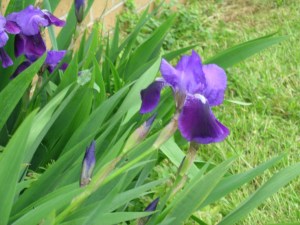
Iris growing at my folks' place...

Time for me to calm down. I need to read Gin’s blog. And Patricia’s and Hilary’s. Meanwhile, I found this from Alan Watts’ Nature, Man and Woman

“Love brings the real, and not just the ideal, vision of what others are because it is a glimpse of what we are bodily. For what is ordinarily called the body is an abstraction. It is the conventional fiction of an object seen apart from its relation to the universe, without which it has no reality whatsoever. But the mysterious and unsought uprising of love is the experience of complete relationship with another, transforming our vision not only of the beloved but of the whole world…

…in a relationship which has no goal other than itself, nothing is merely preliminary. One finds out what it can mean simply to look at the other person, to touch hands, or to listen to the voice. If these contacts are not regarded as leading to something else, but rather allowed to come to one’s consciousness as if the source of activity lay in them and not in the will, they become sensations of immense subtlety and richness. Received thus, the external world acquires a liveliness which one ordinarily associates only with one’s own bodily activity, and from this comes the sensation that one’s body somehow includes the external world.”

When we can feel that level of unity, we cherish those events that nurture our unity and we mourn those that tear us apart. And we fight for what will keep us all free enough to be connected in healthy mind/body/spirit appreciation.

jrk

Spontaneity . . .

“Spontaneity is, after all, total sincerity–the whole being involved in the act without the slightest reservation–and as a rule the civilized adult is goaded into it only by abject despair, intolerable suffering, or imminent death. Hence the proverb, ‘Man’s extremity is God’s opportunity.’ Thus a modern Hindu sage has remarked that the first thing he has to teach Westerners who come to him is how to cry, which also goes to show that our spontaneity is inhibited not only by the ego-complex as such but also by the Anglo-Saxon conception of masculinity. So far from being a form of strength, the masculine rigidity and toughness which we affect is nothing more than an emotional paralysis. It is assumed not because we are in control of our feelings but because we fear them, along with everything in our nature that is symbolically feminine and yielding. But a man who is emotionally paralyzed cannot be male, that is, he cannot be male in relation to female, for if he is to relate to a woman there must be something of the woman in his nature…

Childlikeness, or artless simplicity, is the ideal of the artist no less than of the sage, for it is to perform the work of art or of life without the least trace of affectation, of being in two minds. But the way to the child is through the woman, through the yielding to spontaneity, through giving in to just what one is, moment by moment, in the ceaselessly changing course of nature.”

Alan WattsNature, Man and Woman

I could repeat this bit over and over:  “But the way to the child is through the woman, through the yielding to spontaneity, through giving in to just what one is, moment by moment, in the ceaselessly changing course of nature.”

Again…

“But the way to the child is through the woman,

through the yielding to spontaneity,

through giving in to

just what

one is,

moment by moment,

in the ceaselessly changing

course of nature.”

the ceaselessly changing course

And without being split, in two minds – we come to a wholeness of expression in life.  We unite the maculine and the feminine within, without destroying one or the other. This dynamic of spontaneity in personhood is so vital. And it haunts at every stop, every start, every juncture in life, every intersection and possibility. Spontaneity. And the way to the child through yielding.

My kids remind me of this daily and sometimes especially along the Tallulah River…

jrk

Acceptance, Allowing, Ah Ha . . .


“Those who are fortunate enough to escape the worst that can happen are nevertheless tormented with imaginations of what might be, and their skins tingle and their stomachs turn in sympathy and horror at the fate of others.


It is little wonder, then, that we seek detachment from the body, wanting to convince ourselves that the real “I” is not this quaking mass of tissue with all its repulsive possibilities for pain and corruption. It is little wonder that we expect religions, philosophies, and other forms of wisdom to show us above all else a way of deliverance from suffering, from the plight of being a soft body in a world of hard reality. Sometimes therefore it seems that the answer is to match hardness with hardness, to identify ourselves with a spirit which has principles but no feelings, to despise and mortify the body, and to withdraw into the comfortably fleshless world of abstract thought or psychic fantasy. To match the hardness of facts we then identify our minds with such symbols of fixity, entity, and power as the ego, the will and the immortal soul, believing ourselves to belong in our inmost being to a realm of spirit beyond both the hardness of fact and the weakness of flesh. This is, as it were, a shrinking of consciousness from its environment of pain, gathering itself back and back into a knot around its own center.


Yet it is just in this shrinking and hardening that consciousness not only loses its true strength but also aggravates its plight. For the withdrawal from suffering is also suffering, such that the restricted and enclosed consciousness of the ego is really a spasm of fear. As a man with a stomach wound craves water, which it is fatal to drink, the mind’s chronic withdrawal from suffering renders it just that much more vulnerable. Fully expanded, consciousness feels an identity with the whole world, but contracted it is the more inescapably attached to a single minute and perishable organism…unless the organism can feel pain, it cannot withdraw from danger, so that the unwillingness to be able to be hurt is in fact suicidal, whereas the simple retreat from an occasion of pain is not. It is true that we want to have our cake and eat it: we want to be sensitive and alive, but not sensitive to suffering…


We revolt at the prospect of our own orgiastic reactions to pain because they are in flat contradiction with our socially conditioned image of ourselves.


The more we defend, the more we suffer, and defending is itself suffering. Although we cannot help putting up the psychological defense, it dissolves when it is seen that the defense is all of a piece with what we are defending ourselves against.”


Alan Watts – Nature, Man and Woman


All of a piece…I love this. You grab a tar baby when you defend against. As long as the motive is a reaction against the feared reality, you are hugging the very thing and drawing into yourself the energy of that which you want to avoid.


Then there is a deeper move. It’s one of opening up to life, like a lover opens up to the ministrations of love. Even if the move amounts to a more kink-type “move” like a lashing headache. Maybe all things coming at me are part of an opportunity and not an attack – such acceptance births newness. Deciding that each experience is an opportunity to transmute in love or in simple acceptance, I find an embrace of what is. I may find myself embracing retreat to restore strength, to ready for the next roundy round with the next big “is” of pain or delight.


At the point of “is” I may have the visual disturbance of a minor migraine emerging. I can get angry, irritated and panicky. Why the hell did this come find me NOW? What is it I believe that is opening the door to this hijacked moment? I did that yesterday. Fixing breakfast for my kids, having awakened feeling engulfed in bliss. I rounded this corner blithely floating along and slam. Bamming surprise sang a challenge. No, it cannot be happening. That is not a curved jagged neon flashing disintegration of my morning vision. No, it is not going to start pounding or hinder my vision. No. No. Bright. Flash. Pound. Smear the jelly on a sandwich for lunch. Cubic neon morning light posing kitchen table pulsing images shattered but put back together in a mosaic of vibrating view, edges not quite aligned. The head rages. I rage. No. No. No.


It was not until yes welled up within that I found the strength to simply rest in being my way through a mild headache. It had been preceded by dizziness. Not that this is the norm, but I wound up mowing the lawn. I did it by accepting my way through the process of feeling pain. I was not refusing the pain. I was saying “Okay. Let’s dance.” There is a surrender that does not capitulate to pain as a “bad guy.” I decided to partake of the energy of resilience. Every part of me was saying: Keep on. Keep on. What can you do? How can you affirm the truth that you’re not at the mercy of life, life is not some cruel toying master lording your time over you like a rare morsel? Life is asking you to learn more.


Some days, there’s no dance. There’s rest and only the quiet hum of silence attending the weary flesh of one who knows her limits and wants to live a long life. Pain or not.

High Wattage for Sustainable Living . . .

The layers of tending the moment and time as a timeless work of beingness and growth are diverse and yet consistently weave one song, a song of unity in love (even when we’re bickering). The work of tending the moment reveals an unmatched value in knowing that we are all one, that humanity is one great pulsing unfolding of life, of love and of those miscarriages of love. We are not as much apart from each other as we believe ourselves to be, no matter how we differ. We all run after love’s best. We stumble. We get up and try again. Even those most fundamentalist, most seemingly given over to the grand quest of “rightness,” are reacting in fear against love’s losses. It is a destructive work, rarely building love. But the motive, under layers of stiff, dry harsh “thou shaltness,” is that cry for love.


If life were meant to be lived for an ultimate tangible goal or manifestation (beyond all that is perfectly love-being now), if it were about the ultimate one grand thing, we would wither up and die. But it is for the eternal here, destination now-is-love. And yet most of us can’t not know how now effects the future. It’s a good thing that we are stuck with this weighing of one thing (the future) against the other (the immeasurable preciousness of resting into the moment). Alan Watts touches on this idea in his book, “Behold The Spirit” and makes clear how contrasts and contradictions provide the perfect manifestation of humanity’s song and unfolds a diligence born not of burdensome rightness but of rest:


“As transparency, or emptiness, lends clarity and definition to form, I find that the more I understand that I am the Happening, and can make no mistake, the more I appreciate every kind of careful and formal discipline and technique. You are somehow freed to do things lovingly and well when you realize that you are not doing anything out of duty or obligation to an overlord. When you no longer make the distinction between the universe and how you are acting upon it, you are really on your own and do acquire a sense of responsibility. And to the degree that we develop (or that there grows in us) this sense of compassionate, as distinct from anxious, carefulness we shall be able to do without the State just as we have been learning to do without the Church.”


Or we are simply learning to do without any overlord or overbearing straining sense of mustness within the Church, within government, within the soul – except when something vital is threatened.


I’m going through a “ness” phase and it’s indicative of the weaving of threads of constancy. There is that presence of perpetual MUST, SHOULD. Or…shouldness. Mustness. They become the great overlords, the teacher with the ruler smacking down hard on the knuckles of alleged wrong. Or the soothing restfulNESS of calm meaning. “Good morning Sweetness…”


An example of this struggle between the overlord and the rest for me personally reveals itself in my juggling of a million things important to me, things that seem to want to tear at purpose here while building up purpose there. I am a mother. I am a woman. I need employment more steady but that won’t kick in a backlash of chronic fatigue syndrome horror. I need to go to school full time but. Those things don’t always want to work together. But I MUST…take care of… me. And them. And. And that. And. When it all boils into a cauldron of shouldness, the flow is gone. The sense of the moment malleable and fat with meaning dries up, blasted away in the tsunami of obligation and of those solid imperatives snarling. Even the obligation to take care of “just me.” The ability to trust life, to trust self evaporates in the boil of shouldness, the ultimate overlord.


Or, as is beautifully described here – “I’ll Take Plastic” – we go through a wrestling match over how “green” we are or are not, how “organic,” or how “sustainable” is our living. It is an endless fatiguing effort when we cannot simply rest into it and do what we are able to do.


But some of us are more sensitive to these things than others. We need the words of Watts and others who have learned to both let go and grasp the vision of why any reality of living matters. We need to be able to identify which imperative layers of concern are most important now and which ones can rest ‘til later. To let go of fear, to let go of the overlord and rest in confidence that we are all part of a grand scheme of love proving love, that we are one in this work is to be freed of any sense of responsibility as a burden. Responsibility and diligence in life become and are, instead, another act of love.


jruthkelly © 2009

New Eyes For Ourselves. . .

“..rapport with the marvellously purposeless world of nature gives us new eyes for ourselves – eyes in which our very self-importance is not condemned, but seen as something quite other than what it imagines itself to be. In this light all the weirdly abstract and pompous pursuits of men are suddenly transformed into natural marvels of the same order as the immense beaks of the toucans and hornbills, the fabulous tails of the birds of paradise, the towering necks of the giraffes, and the vividly polychromed posteriors of the baboon.” Alan WattsNature, Man and Woman

cr-mot-mot
Courtesy of Dave Grant