In the woods somewhere
sweet swaying songs bear witness
to wounds deep, the worst sort
of gutting, how large the teeth,
and how far I’d seeped and seeped
and seeped completely down in seed
and in a gone-ing, a yawning crypt
held and holding eruptions,
creations’ secret reddest colors
for deeply hewn stutters fluttering
across a canvas as yet unknown
‘til my heart knew
and out I flew into one,
and one and one, (yet still One)
and yet still not knowing the known
and the hiding
from a creature lunging,
a bite’s longest reach
still bleeding,
but an ancient design called,
a bridge eternal healing,
deepest love promising,
then subsiding
‘til the singing resurrection,
a transformation from tomb
to tower to long desperate hours
within hours and hours blending
miracles wending, sending
every inch of me calling,
falling up and all over every spec,
dot, bindu, wreck not wrecking
as the beckoning out
of richest colors wrought whole
and healing a song
to raise the dead,
to know the unknowing
into love flowing
rivers, a heaven on earth begging…
I Believe Her
The Door…
Shared with me from a friend’s beautiful feast of a blog, Trail of Leaves: “If I were to be asked what we are, I should answer: ‘We are the door to everything that can be, we are the expectation that no material response can satisfy, no trick with words can deceive. We seek the heights. Each one of us can ignore this search if he has a mind to, but mankind as a whole aspires to these heights; they are the only definition of his nature, his only justification and significance.’
[…]
The supreme questioning is that to which the answer is the supreme moment of eroticism—that of eroticism’s silence.”
George Bataille – Death and Sensuality
So Something Soul
Wish Jesus could’ve come in a flash
of flesh melding flesh for flesh for all we’re here for
and nothing more
but they so scared say
he came through the neatest arrangement of dry
no muss no fuss conception
shedding true believers of their best jiving stuff
and cursing us all to a damning salvation
bathed in a glory dimming
the harlot’s perpetual virginity in love.
Wish Jesus’ immaculation could’ve been
the most blessed jiving ‘jaculation
wresting us all from fear.
But no…it isn’t so something soul…
no sweet rolling liquid fullness
or bang bam zoom us all
into something more truly respectful
of the sacred soulful wonder fusing one with other
and making yet another
and then some, maybe even a nation
of lovers begetting lovers
ending war in a sometimes martial dance
refusing anything but final fusion.
Wish Jesus’ conception hadn’t been bound
to a story divorced from the wildness of the dance,
immaculately fretting us all into any song but the one,
the whimsical fierce guitar strumming us into wholeness,
singing us, us the song of surrender resisting the futility of shame, shame, shame.
Wish it were so something soul and then we’d all be free.
====
But it can be, can’t it? Immaculate conception is ancient. It is now. It is then and there when man or woman is penetrated by the creator spirit and a gestation supreme begins. The shame mentioned in this outpouring comes not from the work of an ancient alchemical process but from the distortion of sexuality by minds afraid of their own bodies, their own strumming potential…
Stirring It Up – Pure Lust
“Dionysian surrender to life includes an ego-relaxed receptivity to sexuality, a willingness to let life be shaped by desire and by sexual inclination. Yet when this Dionysian spirit is linked to the compassionate eros of Jesus, it takes an unusual form, becoming an emotional oxymoron – carnal chastity, promiscuous compassion, or, in the perfect phrase of Mary Daly, pure lust.
The Dionysian spirit is usually seen as a sexually expansive force, and so it is not obvious in some portraits of Jesus…Ruether concludes that ‘Jesus appears to be a person unperturbed by sexuality because he relates to both men and women first of all as friends.’ …
The image of Jesus suggests a way of placing limits that derives from joy and pleasure rather than fear and anxiety, limits determined by a positive choice in life. Jesus seems to suggest joyful celibacy and then to tolerate the struggles of others to establish their ways of being sexual and their ways of finding limits. …
The sexuality of Jesus consists in his openness to strangers and friends, the physicality of his healing, the sacramentality in his approach to food, the tolerance he displays in the face of sexual transgression, and his espousal of a philosophy based on love. Only a worldview mired in materialism could fail to see the sexuality in this expansive and inclusive erotic philosophy. The sexual teachings of Jesus, told best through his example, present a soul-centered eroticism in which friendship and a compassionate heart are not only included but placed at the center.
We have a strong tendency to think of sex as emanating from the sex organs or from the purely physical body, but Jesus demonstrates a quite different notion – sexuality rooted in compassion and in the capacity for friendship. It is a more broadly defined but no less sensuous sexuality, in which love and pleasure are joined integrally. There is no need to import affection to what is thought to be a plain physical expression or to justify sex with love. In the sexuality of Jesus physical lifea nd compassion are two sides of a coin. In him we find that the heart is an organ of sex, as surely and effectively as any other private part.” – Thomas Moore, The Soul of Sex
Some could consider this “sacreligious” but it resonates for me, deeply, since I’ve been examining the impact of fear-filled religious dogma on my own concept of myself as a sexual being. Marriage. Divorce. Dating. Sex. Motherhood. Academia. Writing. Art. What breathes life into any of these realities? Love. But going deeper into love, what “type” of love? Can I identify one that feeds all relationships with innocence and grace? What infuses everything? I keep landing on one: Eros. When fear melts away, when shame fizzles out in the light of the sun, when power struggles are stripped of their inferior control-frenzied gropings, eros is given the room to express and infuse itself into every layer of living as that pure lifeforce, erupting in poetic spill or artistic flow, feeding the motions of care-taking in all its forms, impassioning the goals for fitness or achievement of any form. Erotic love is not about fitting into a role as a married person or a saint or a sex symbol or a captured image of acceptable (or taboo oo oo) sexual functions. It is the infusion, the flow, the glow of surrendering to being alive with pleasure no matter your status.
Right now my status is boiling over a cauldron of change and growth and and and. I just might be late for class if I don’t kick it in. But I’m going to do it making love to life every step of the way. Jump and jive…
Schoolgirl?!
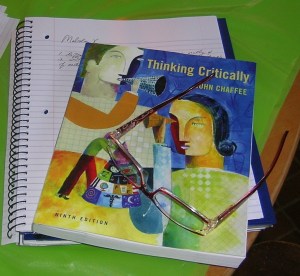
My words are being used for classes drowning me in homework, essay preps and speeches down the road. Day two and I’ve spent an hour and a half running through the exercises for my Critical Thinking class.
I know it’s basic. But it takes time I had been using elsewhere. I find my creative flow is used up when I sit down to blog. Og og og… But I’m loving Fromm in my mini-breaks from homework (I love homework. Been doing it for over 2 decades but only within the constraints of my personal dictates.). He puts Freud in proper perspective and love in a place that is accessible, solid and without illusion. Not for the faint-hearted and a sure cure for narcissistic distortions.
So, since I’ve got to next focus on what I see unfolding for me in my Public Speaking class, Western World Lit – Advanced (omg, killing me after years of falling in love with the mind of the East) and Statistics, I’m tossing Fromm quotes on the table for “fun.” These are speaking to me lately since I tend to rant about love and quote greats on love and nowhere do I try to identify what it is (as if! cough…). I see, know and experience love on spiritual levels that play out on the solid physical planes of existence and my ability to put it into words that adequately conveys is lacking. I tend to go off on poetic rambles useful only to myself. Fromm, on the other hand, has mastered the best definition I have yet to find or create. To start with, he slices and dices at what love is NOT:
“Automatons cannot love; they can exchange their ‘personality packages’ and hope for a fair bargain.”
“Love is not the result of adequate sexual satisfaction, but sexual happiness–even the knowlede of the so-called sexual technique–is the result of love…The study of the most frequent sexual problems…shows that the cause does not lie in a lack of knowledge of the right technique, but in the inhibitions which make it impossible to love.”
“Love as mutual sexual satisfaction, and love as ‘teamwork’ and as a haven from aloneness, are the two ‘normal’ forms of the disintegration of love in modern Western society, the socially patterned pathology of love.”
“Another form of pseudo-love is what may be called ‘sentimental love.’ Its essence lies in the fact that love is experienced only in phantasy and not in the here-and-now relationship to another person who is real…As long as love is a daydream, they [lovers/partners] can participate; as soon as it comes down to the reality of the relationship between two real people–they are frozen.”
And here’s my favorite identification of what love IS:
“Love is possible only if two persons communicate with each other from the center of their existence, hence if each one of them experiences himself from the center of his existence. Only in this ‘central experience’ is human reality, only here is aliveness, only here is the basis for love.
Love, experienced thus, is a constant challenge; it is not a resting place[!!!], but a moving, growing, working together; even whether there is harmony or conflict, joy or sadness, is secondary to the fundamental fact that two people experience themselves from the essence of their existence, that they are one with each other by being one with themselves [emphasis mine], rather than by fleeing from themselves. There is only one proof for the presence of love: the depth of the relationship, and the aliveness and strength in each person concerned; this is the fruit by which love is recognized.”
These all come from Fromm’s awesome book, The Art of Loving. And I’ve likely already put it on this blog. Maybe not. But it’s worth embracing, revolutionizing a life intent on knowing and being known in love, as love, for love, by love…you get it.
jrk
Come Again?
Pun intended? Maybe…
“It will by now be clear that a truly natural sexuality is by no means a spontaneity in the sense of promiscuity breaking loose from restraint. No more is it the colorlessly ‘healthy’ sexuality of mere animal release from biological tension. To the degree that we do not yet know what man is, we do not yet know what human sexuality is. We do not know what man is so long as we know him
piecemeal,
categorically,
as the separate individual,
the agglomeration of
blocklike instincts and
passions and
sensations regarded
one
by
one
under the fixed stare of
an exclusive consciousness.
What man is, and what human sexuality is, will come to be known only as we lay ourselves open to experience with the full sensitivity of feeling which does not grasp.”
Alan Watts – Nature, Man and Woman
And we get there by consciously laying aside our “graspers” or ideas of what we’re going to be holding when we reach out either in eros, in friendship, or any loveflow. It’s sometimes like leaping off a cliff right there in the moment. You step off the platform erected in stereotypes, gender bias and and and.
Come again into the moment without your idealogical “garments” and your doctrinal fig leaves and know life. Re-enter, repeat, re-do. Renew. Yes, the pun was intended but some of the more whimsical attention grabbing “pick-up” lines lead you into release from rigidity of expectations born in control-motivated modes of “relating” and “knowing.”
jrk
Peace? Personal Growth? Pish Posh?!
What is personal growth anyway? Is it a process of losing immaturity and facing the facts of life? Is it a coming into peace? Is it the development of personal ideals into a vision of life? How can any of it begin to be possible without peace? Ever try to build a tent in a storm? Growth is like that tent-pitching adventure. We set up camp here and then there as we explore a terrain on a journey of wholeness, richness of living. How do we get there in turmoil?
The whole idea of feeling at peace with your self, with life, with others often – by its sheer contradiction to reality – lands on the mind with a comical mockery of all the chaos, internal agony and daily inundation of responsibility. Peace? Right! And the fairies leave me gold coins under the magnolia every evening! It can sound that ludicrous. Then we face the semantics of “finding” peace, even in a quiet home, sitting in “optimum” meditative pose (as if!). With all else clamoring within and around the next bend, it can feel like a gargantuan striving to be “at peace.” So many things in life scream out: “I am more real and more important!” The contrast of those screaming demands and issues pose the notion of peace as comical and the one contemplating it worthy of contempt or ridicule. The roof may cave in with the financial disaster. I might produce the same orphaning of my children though I’m technically more here than my parents were. There’s too much to do to even begin to imagine what it would be like to be a smooth-running overflowing river of peace in the middle of it all. Too much nips at the heels daily.
So, sit and rest into a sense of wholeness, peace? RIGHT! Besides, the attempt can, by its own efforts, destroy any suggestion of peace. So, it seems impossible. But it’s not.
There are layers to tend to first.
1) Focus on the body’s language
2) Acknowledge and work through (lifetime work) the injuries of the past that continue to visit today.
3) Establish a vision that will make possible the management of now’s needs and desires in conjunction with the repair work needful to relieve pain from past injuries. E.g. A person needs to feel capable of being present on certain levels with those s/he cherishes without the paralysis and inhibition created in fear of repeating history. There are ways to work through both needs. The importance of now and the critical drain of concern about the effects of the past on a life – these are both vital concerns. One does not negate the other. Your power is now. Sure. But that does not diminish how the past still needs a measure of your regard and attention. Development is essential in making the most of the power of your now. But…development is facilitated by recognition of what is NOT developed because of past influences. We can run. We can hide. But it profits us little in terms of depth change, the type of transformation that brings a person into a place of full presence, making the life a feast for self and for loved ones.
4) Recognize the path of peace is a process of increasing awareness, allowance, integration and release built on a foundation of self-acceptance and sobriety. All while making sure to grow and hold loosely to your dynamic vision of life as you, you as life.
5) Grow a sense of unity with all in an ever-increasing expansion of wholeness within, shedding perspectives of isolation and judgement.
Stay tuned… for a glimpse into the first layer mentioned above. Find a place today, a soothing place, sit with yourself and call every part of you that has been scattered back home. Visualization, as much as it cannot be proven, measured or otherwise grasped with anything tangible, is still a highly powerful tool of self-restoration, especially when feelings are allowed to have their full play without fear.
Sexuality and Nature…Forces of Evil?
Quoted from Nature, Man and Woman by Alan Watts.
This puts me in remembrance of the idea of “fallen” man. And woman. “The woman thou gavest me…” It draws up from the wellspring of my own personal experiences and takes me to that place where I recognized one thing pivotal about the Garden of Eden. The tree was that of the knowledge of good and evil. I ventured to see it as a moment of partaking of the awareness that evil exists, that good exists. But to assume that we would then be equipped to determine which is thus was . . . doubtful, a twist of “truth” for the truth that we cannot arrive at God via the knowledge of good and evil. For to be “like God” via that route, that knowing good is and evil is, is not to be Godly but to be a distortion of divinity, a taking on of “God-likeness” from a narrow view. You cannot, after all, see a whole forest when you are fixated on one tree.
Erotic Morality
“Erotic morality reaches deep into the heart and into the community for guidance. It allows time for wisdom to be revealed. It doesn’t define itself against desire or pleasure. It is woven tightly into a whole fabric of values rooted in an affirmation of life and a love of one’s own soul. It is comfortable and in no way exploits or condemns. We discover this erotic morality by knowing our life story well, owning up to our prejudices and negative influences, and embracing our past wounds and failures…it is only in the bittersweet embrace of life that we can find our way to pleasures that complement our moral sensitivity.”